
To switch styles without losing the floor, build a bridge: a track, a loop or a moment that belongs to both sides. A small tempo gap rides on the pitch fader; a big one needs a break, a cut or a track that changes tempo for you.
Why and when to switch
At an open format night (the DJ plays any style the crowd wants, from hip hop to house), switching is the job. In a long set, the room changes: people who danced to afro house at 11 may want tech house by 2. And a flat floor can wake up to a new style.
Do not switch too soon: London Sound Academy tells open format DJs to "create a vibe using several songs in one genre before transitioning to another." The end of a set is a classic spot: in our Tech House crate, "Go Back", a house track with a drum and bass drop, is among the last three tracks of 10 recorded John Summit sets.
Plan the bridge: tempo
The usual ranges from our BPM guide, in beats per minute: amapiano 110 to 118, afro house 118 to 125, house and disco 115 to 128, tech house 122 to 130, melodic house and techno 120 to 128, drum and bass 170 to 180.
- Small steps work when ranges touch: afro house into tech house is a climb of a few BPM over three or four tracks.
- A jump is anything past about 6 percent. House at 124 into drum and bass at 174 is 40 percent: no pitch fader blends that, so you cut, use a break or let a bridge track do it.
- Half-time and double-time. Drum and bass at 174 has a half-time feel: it moves like 87, and your app may show 87. An 87 BPM hip hop track lines up with it, one beat for every two of drum and bass. Phil Morse of Digital DJ Tips calls this "an extreme mix, more suited to lounges, bars and the radio than a dancefloor," unless done really well.
Plan the bridge: key, energy and groove
Key matters wherever two melodies or vocals overlap. Before a long blend, check that both tracks sit on the same number or one step apart on the Camelot wheel (our harmonic mixing guide explains it). If not, keep the overlap short or on the drums.
Energy and groove matter more than the genre name. Match the energy of the room and look for what the styles share:
- Percussion. Afro house and tech house are both built on it, so a drum-heavy afro house track hands over easily. Between amapiano and afro house sits 3 Step, which Beatportal places where amapiano, afro house, afro tech and deep house meet. Thakzin's "The Magnificent Dance" is in both our Afro House and Amapiano crates.
- Vocals. A vocal the crowd knows carries them across a change of beat.
- Basslines. Biscits' "Wait A Minute" is an anthem in both Tech House and Bass House, found in 236 recorded DJ sets.
Bridge tracks: songs in two crates
The easiest switch is a track that belongs to both styles; remixes are made for this. Four from our crates, as of October 2026:
- "Cola" by CamelPhat and Elderbrook is an anthem in both Tech House and Melodic House & Techno, found in 448 recorded DJ sets.
- "Go Back" by John Summit, Sub Focus and Julia Church sits in Tech House and Drum & Bass, found in 110 sets. It changes tempo inside the track: the producers made a house version and a drum and bass version, then merged them, Beatportal explains. Summit: "Looping the vocal was key to making it sound natural during the transition."
- "Tanzania" by Uncle Waffles and Tony Duardo: the original is an Amapiano anthem (23 sets, 113 BPM), Rampa's remix an Afro House anthem (19 sets, 122 BPM). Both are listed in key 2A.
- "It's That Time" by Marlon Hoffstadt: FISHER's remix is in Tech House (78 sets, 130 BPM), Dimension's in Drum & Bass (104 sets, 174 BPM).
Our post on tracks that cross DJ styles has many more.
Four more ways across
- A loop or acapella as glue. Loop four beats of percussion on the outgoing track, let it play twice, move its tempo to the new track's BPM and start the new track on a new phrase (a block of 8, 16 or 32 bars). Or lay an acapella (a vocal on its own) over the first bars of the new style. See hot cues and acapellas.
- Echo or filter out, then drop in. Crossfader suggests an echo set to one beat, at the end of a phrase. Hit it on the last beat, close the fader and start the new track in time with the tail. A filter is the slow version: sweep the old track thin over a phrase, then drop the new one.
- A breakdown into a new intro. When the old track hits a long breakdown (the drums drop out), start a new track that opens with a build-up and fade the old one away. Or cut straight into a long break at the start of the new track: Digital DJ Tips says the crowd forgets the old tempo by the time the beat returns.
- A reset. A second of silence after a big ending, then a clean start. Or a track everyone knows: "Show Me Love" by Robin S is found in 820 recorded sets in our House & Disco crate.
Tempo ramps: pitch fader limits and key lock
The pitch fader changes a track's speed by a percentage. Club players offer plus or minus 6, 10 and 16 percent and WIDE; pick the narrowest range that covers your move.
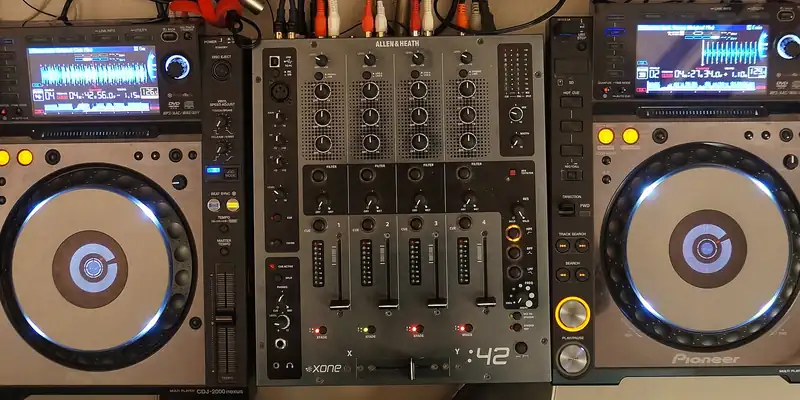
- Turn key lock on (master tempo on club players) first. About 6 percent of tempo equals one semitone, so without it a vocal pushed that far sounds off.
- Move in small steps during sparse parts: Digital DJ Tips suggests about 1 BPM every 30 seconds.
- Meet in the middle. For "Tanzania" (113) into Rampa's remix (122), push the original up about 4 percent to 117 and play the remix 4 percent slow.
- Ease back. Key lock stretches the audio, and pushed far it can sound "unacceptably stuttery or dull," as Digital DJ Tips puts it. When the new style has settled, bring the fader back toward 0.
Common mistakes
- Jumping tempo during a busy part. Under a drop or a chorus, both tracks fight. Wait for a break or the end of a phrase.
- Clashing keys. A long blend in clashing keys sounds sour: check the wheel first.
- Too many switches. For big tempo cuts, Digital DJ Tips' rule of thumb is "one or two times a set."
- Leaving a full floor. If the room is going, the plan can wait.
To find your own bridges, open two crates on the all styles page, play the 30-second previews and save the tracks that work on both sides to your crate with the + button.
Sources: Digital DJ Tips, Crossfader, London Sound Academy, Beatportal (Go Back), Beatportal (3Step).