
A one-hour festival set and a four-hour club set are different jobs. At a festival you get a short, fixed window in front of people who can walk to another stage, so you start strong, plan your peaks and stop on the minute. In a long club set you are the whole night, so you pace it like a journey, with room for deeper tracks, builds and rests.
Why they are different jobs
- Attention. At a festival, people drift to another stage or the bar at any moment. In a club, they chose one room for the night.
- Who came for you. A festival crowd came for the lineup, and part of it is waiting for the act after you. When you play four hours in a club, many came for you.
- Sound and stage. A main stage is big, often outdoors, where fine details get lost and clear grooves carry. A club holds the sound close, so deeper tracks still work.
- The changeover (the handover between two DJs) happens at a set time, often with a crew working around you.
- The end time. The next act and the curfew (the time the sound must stop) do not wait.
John 00 Fleming, a trance DJ known for marathon sets, wrote on his blog in December 2025: "With 60-minute sets there's no margin for error." In a club, he says, "I can reset the vibe, take my time, and unfold a musical story."
How many tracks you need
Do the arithmetic. In a short set you mix early and play the best part of each track, so count 3 to 4 minutes per track: 60 minutes makes 15 to 20 tracks. In a long set, blends get longer, so count 4 to 6 minutes: 240 minutes makes about 40 to 60. Then bring about double, as in how to prepare a DJ set.
| 1-hour festival set | 4-hour club set | |
|---|---|---|
| Minutes per track | 3 to 4 | 4 to 6 |
| Tracks you will play | About 15 to 20 | About 40 to 60 |
| Tracks to bring | 30 to 40 | 80 to 120 |
Estimates that depend on your style and how you mix. Count your own last set.
Real sets vary: Joey Santos of Digital DJ Tips played 149 tracks in eight hours, about 19 an hour. Tempo matters too. A 32-bar intro lasts about 64 seconds at 120 BPM (beats per minute) and 44 seconds at 174 BPM, so faster styles burn through more tracks. See our BPM guide for every style.
The shape of each set
Festival, one hour. No slow warm-up unless you open the stage. Your first track is a statement at the energy the stage already has. Keep slow moments short: a breakdown, one breather. Plan two or three peaks, know which track carries each, and keep one of your strongest for the last ten minutes.
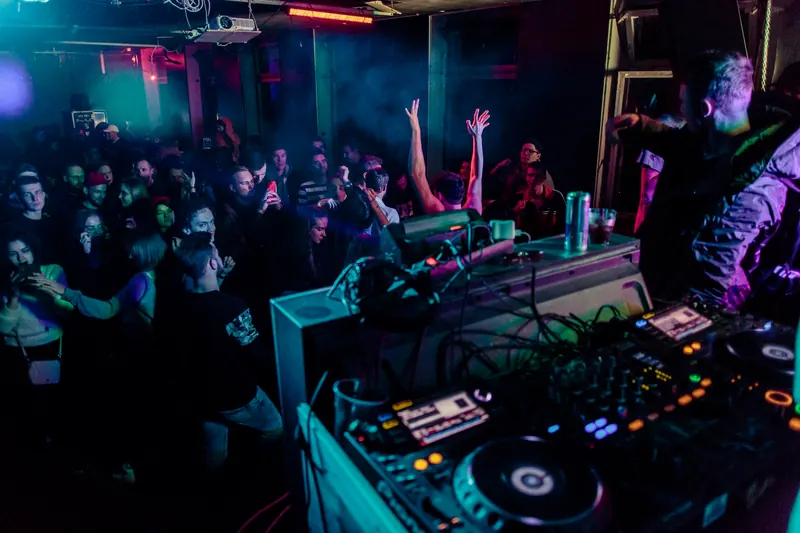
Club, four hours or more. A journey. Start deeper and slower than your peak, build in steps, rest, build again. "It's a case of pacing the music so you don't energise the set too much in the beginning," Sasha told Mixmag in 2015. DJ Harvey, who says he plays for six, eight or ten hours, told SF Weekly, as quoted by DJ TechTools: "You can start ambient, then slowly build up to several peaks during an evening."
How much to plan, how much to improvise
Plan a festival set tightly: your first three tracks, your peaks, your last track and the minute each part starts, with an alternative for each spot. Even so, Fleming never knows exactly what he will play: he arrives early, listens to the DJs before him and reads the crowd. A plan is a map, not a script.
For a long club set, plan zones rather than an order. Digital DJ Tips suggests folders for opening, primetime and closing, with tracks tagged by energy. Then improvise inside them. Our guide on how to read a crowd shows what to watch.
Recognizable tracks or deeper picks
At a festival, many people do not know your name yet. A few tracks they recognize, an anthem of your style or a famous ID (an unreleased track heard in big sets), give them a reason to stay. That does not mean nonstop hits: Fleming plays fresh tracks on purpose. In a long club set, you have time for B-sides, older records and the slow burner that needs eight minutes to make sense.
A style crate on Digger Digger helps with both. Every track shows how many recorded DJ sets it was found in. The tracks found in the most sets are your safe festival moments. The ones found in fewer sets are the deeper picks for a long club journey.
Edits, intros and outros for short sets
Most club tracks have a long beat-only intro and outro for DJs to mix over. In one hour you rarely need all of it. Trance DJ Markus Schulz told Mixed In Key that when he shortens a track, he plays "the main riff and the 'big' parts of the song." So:
- Set cue points (saved start markers) past long intros.
- Look for shorter edits from the artist or label, or make your own and test them at home.
- Mix out before long outros you do not need.
- Keep one track with a clean outro for the end, so the next DJ can mix in.
Stamina, water and breaks for long sets
- Water. Keep it in the booth. DJ TechTools suggests drinking as much water as alcohol if you drink at all.
- Food. Eat before you play and bring a snack. Lee Burridge told Mixmag: "I make sure I have pizza, to be delivered around hour ten." Danny Tenaglia might have a banana or a coffee past the eight-hour mark.
- Breaks. For a toilet break, Digital DJ Tips suggests putting on a long track. Know which ones you have.
- Your body. Supportive shoes and gear at a comfortable height matter more in hour four than in hour one.
Famous long sets
All-night sets were once the norm: Mixmag notes that pioneers like Frankie Knuckles, Ron Hardy and Larry Levan often played 12 to 14-hour shifts. Mixmag's list of marathon sets includes Carl Cox's nine-hour set closing his 14-year residency at Space Ibiza in 2016, UK garage pioneer DJ EZ's 24-hour set for cancer research the same year, and Danny Tenaglia, who made 12-hour sets his signature. Four hours is already a long story.
The festival changeover and starting on time
- Arrive early. Find the stage manager, check your set time and ask how the changeover works there: a second setup, shared players or a quick swap.
- Be ready. First track loaded, headphones plugged in. Listen to the DJ before you, so you start near their tempo and energy.
- Start on the minute. A late start does not move the end time. At Glastonbury on June 24, 2023, Lana Del Rey began her headline set about 30 minutes late, and the power was cut at the midnight curfew in the middle of a song, Rolling Stone reported. A DJ slot works the same way.
- Finish on the minute. Know your last track and when it must start: see how to close a DJ set. Playing before the big names? What to play when you open for a big DJ applies on a festival stage too.
Whichever set comes next, start from the right crate. Open your style in all styles, play the 30-second previews and save tracks with the + button: the ones found in the most sets for your festival peaks, the deeper ones for your long nights.
Sources: John 00 Fleming, Mixmag, Mixmag, DJ TechTools, Digital DJ Tips, Mixed In Key.